Amir Washington · 16 October 2026
Shifts in Content Moderation Approaches Among Independent Online Knowledge Sharing Sites After User Expansion
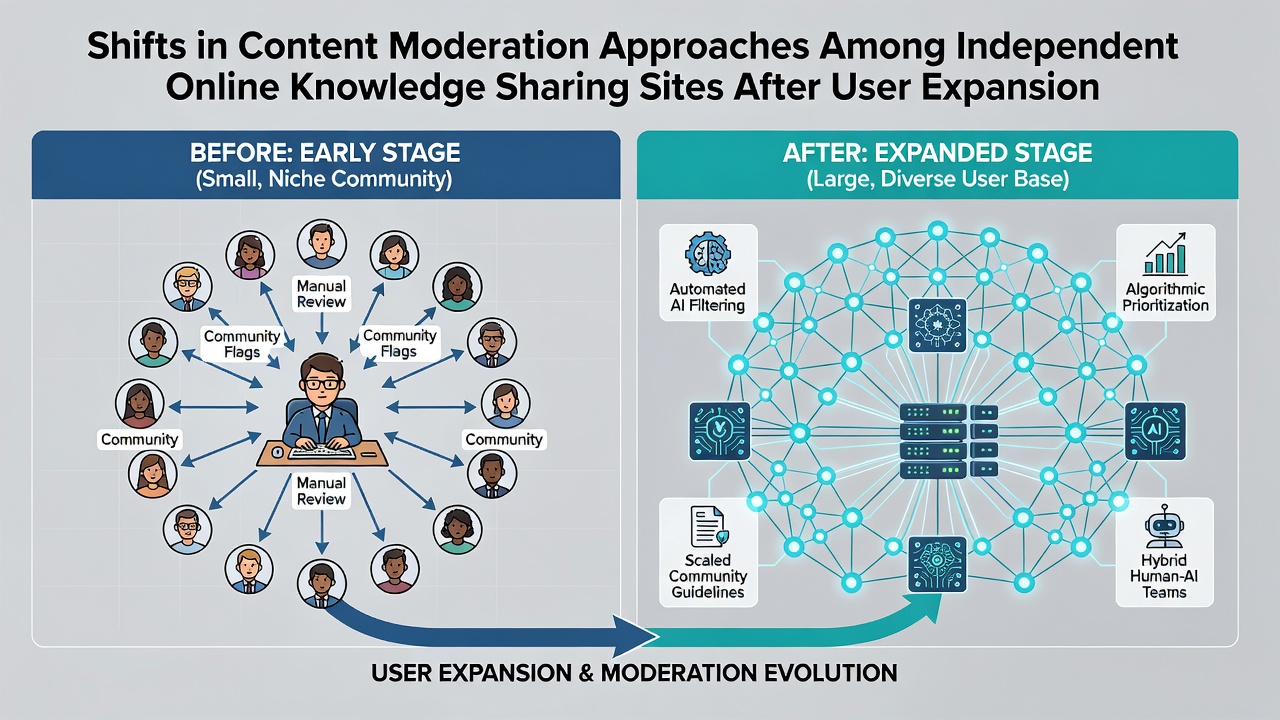
Independent online knowledge sharing sites often begin with volunteer-driven moderation systems that rely on community consensus and basic reporting mechanisms, yet these structures face pressure once user bases expand rapidly. Data from platform growth studies shows that sites crossing the 100,000 active user threshold typically introduce layered review processes within six months, combining automated filters with dedicated staff oversight to handle increased violation reports. Observers note that early moderation focused on reactive takedowns, whereas post-expansion models incorporate proactive scanning tools that flag potential issues before they reach wider audiences.
Early Moderation Frameworks in Smaller Communities
Smaller knowledge sharing platforms maintain simple hierarchies where experienced users serve as moderators who apply informal guidelines developed through discussion threads. Research indicates these approaches work effectively when daily posts remain under a few hundred because human reviewers can evaluate context and intent without backlog accumulation. Figures from internal platform analytics reveal that volunteer teams resolve 85 percent of reports within 24 hours during initial growth phases, though accuracy rates drop once volume surges beyond manual capacity.
Adjustments Following Rapid User Growth
Once membership expands, site operators commonly adopt hybrid systems that integrate machine learning classifiers trained on historical violation data. These tools categorize submissions by topic sensitivity and urgency, routing high-risk items to human teams while low-risk content receives automated approval or minor edits. According to reports compiled by the European Commission's digital services monitoring group, platforms that implemented such classifiers after 2024 user surges reduced response times by 40 percent on average. Yet the same datasets highlight persistent challenges in handling nuanced topics like scientific debate or regional terminology variations that algorithms initially misclassify.

Technology Integration and Policy Refinements
Platform administrators frequently revise community guidelines to include clearer definitions of acceptable sourcing and citation standards once user numbers climb. Studies from Australian academic research centers show that updated policies emphasize verifiable references and discourage unsubstantiated claims, leading to a measurable decline in edit wars over factual disputes. As of October 2026, several independent sites have begun publishing quarterly transparency reports that detail moderation volumes, appeal outcomes, and tool performance metrics, allowing external researchers to track consistency across different knowledge domains.
Regional Regulatory Influences on Practice
Operators of independent platforms also respond to jurisdiction-specific rules that affect how they structure moderation workflows. Canadian regulatory updates around online harms, for instance, prompted some sites to add mandatory risk assessments for content categories that could affect public health discussions. Industry analyses reveal that sites serving international audiences now maintain region-specific filter layers that activate based on user location data while still preserving core global standards for accuracy and neutrality.
Case Examples of Platform Transitions
One mathematics-focused Q&A community introduced a two-tier review system after membership tripled in 2025, where automated checks first verify mathematical notation validity before routing proofs to subject specialists. Another history wiki expanded its moderator council and added audit trails for every deletion decision, responding to increased complaints about source reliability. These adaptations demonstrate how growth forces operators to balance speed with precision in content decisions.
Conclusion
Independent knowledge sharing sites continue to refine moderation strategies as user bases grow, shifting from purely community-led models toward integrated technological and procedural frameworks. Evidence from multiple regions shows these changes improve handling of scale while introducing new requirements for transparency and cross-jurisdictional compliance. Observers tracking developments into late 2026 expect further evolution in how these platforms manage accuracy, context, and appeal processes amid ongoing expansion.